AI ideas are easy to find. The harder part is turning them into something people can actually use at work.
A team needs a better approval flow. A warehouse needs a small app for a process gap. Finance wants fewer manual handoffs. IT needs to connect SAP and non-SAP systems without creating another mess of custom code. That is where SAP Business Technology Platform fits.
AI gets the attention, but applications make the work usable. SAP BTP helps turn business ideas into apps, integrations, automations, and extensions that can support real ERP work.
Why this matters now:
- A process gap gets filled with a spreadsheet
- A manual approval gets handled by email
- A team builds a workaround outside the ERP core
- A report pulls data from too many places
- A useful idea gets stuck because changing the core feels too risky
Individually, these issues may not feel huge. Together, they slow people down and make future change harder. SAP BTP matters because it gives business and IT teams a cleaner place to build, connect, automate, and extend without pushing every change directly into the ERP core.
What SAP BTP changes
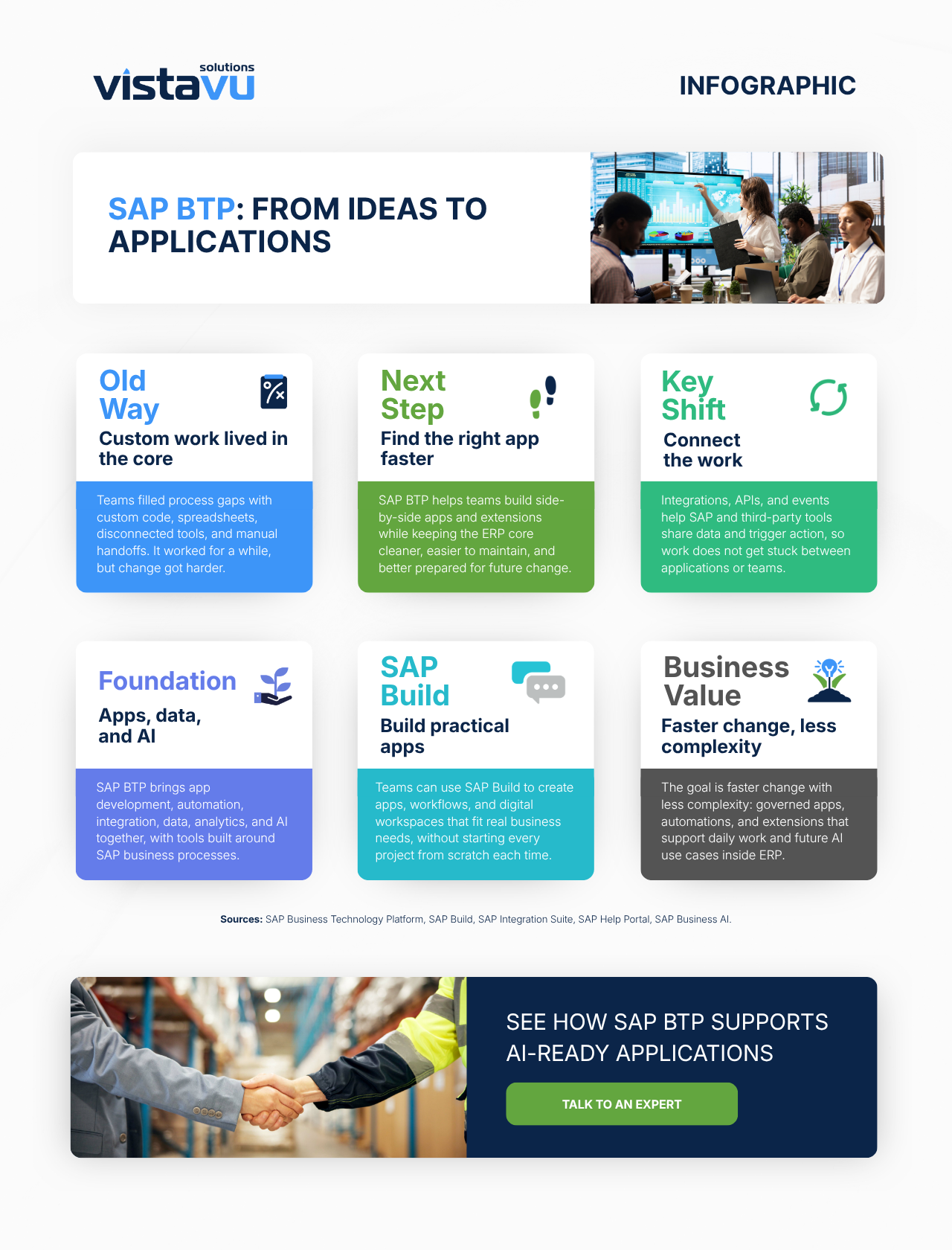
SAP BTP is not just one tool. SAP positions it as the layer for building, integrating, automating, managing data, and extending applications in a governed way. In practical business terms, it helps companies turn a real need into something usable.
That could mean:
- A custom application for a specific process
- A workflow that replaces manual approvals
- An integration between SAP and a third-party system
- A side-by-side extension that keeps the ERP core cleaner
- A data or analytics experience that gives people better visibility
- An AI-supported process grounded in trusted business context
The point is not to build technology for the sake of it. The point is to make the business easier to run.
The old way vs. the better way
| The old way |
What it leads to |
The better way with SAP BTP |
| Custom code lives directly in the ERP core |
Upgrades get harder and changes take longer |
Build side-by-side extensions while keeping the core cleaner |
| Teams rely on spreadsheets and email handoffs |
Work becomes hard to track and easy to miss |
Use apps and workflows that guide the process |
| Systems do not talk to each other well |
People re-enter data and compare different versions of the truth |
Connect SAP and non-SAP systems through integration |
| Every idea becomes a one-off project |
IT gets overloaded and business teams wait |
Use reusable tools for apps, automation, and integration |
| AI starts before process context is ready |
Results can be disconnected from how work actually happens |
Ground AI in applications, data, and business processes |
The old way
Custom code lives directly in the ERP core
What it leads to
Upgrades get harder and changes take longer
The better way
Build side-by-side extensions while keeping the core cleaner
The old way
Teams rely on spreadsheets and email handoffs
What it leads to
Work becomes hard to track and easy to miss
The better way
Use apps and workflows that guide the process
The old way
Systems do not talk to each other well
What it leads to
People re-enter data and compare different versions of the truth
The better way
Connect SAP and non-SAP systems through integration
The old way
AI starts before process context is ready
What it leads to
Results can be disconnected from how work actually happens
The better way
Ground AI in applications, data, and business processes
The real shift is moving away from scattered workarounds and toward governed applications, extensions, integrations, and automations.
Why the application layer matters
This campaign is built around a simple story: AI. Data. Applications. AI is what people are asking about. Data is what makes AI reliable. But applications are where the work actually happens.
Applications create the business events, rules, approvals, statuses, transactions, and process context that data and AI depend on. If that layer is weak, AI has less to work with. That is why the SAP BTP story matters. It is the layer where companies can start turning business ideas into practical tools.
Apps that help people complete specific tasks
Automations that reduce manual steps
Integrations that connect the process
Extensions that support unique needs without overloading the core
AI-supported experiences that can use real business context
Where SAP BTP fits
Think of SAP BTP as the layer that helps teams build around the ERP without breaking the ERP. That matters because no ERP system covers every edge case perfectly. But the old answer was often heavy customization, and that created problems later.
| Capability |
What it helps with |
Business example |
| Application development |
Build custom apps and extensions |
A field app for approvals, service updates, or warehouse exceptions |
| Automation |
Reduce repeated manual work |
Routing approvals or triggering follow-up tasks |
| Integration |
Connect SAP and third-party systems |
Syncing ERP, CRM, e-commerce, logistics, or finance tools |
| Data and analytics |
Bring better visibility to decisions |
Showing process status, exceptions, or trends in one view |
| AI |
Add intelligence to business processes |
Supporting users with recommendations, summaries, or guided actions |
Application development
Build custom apps and extensions
A field app for approvals, service updates, or warehouse exceptions
Automation
Reduce repeated manual work
Routing approvals or triggering follow-up tasks
Integration
Connect SAP and third-party systems
Syncing ERP, CRM, e-commerce, logistics, or finance tools
Data and analytics
Bring better visibility to decisions
Showing process status, exceptions, or trends in one view
AI
Add intelligence to business processes
Supporting users with recommendations, summaries, or guided actions
Why clean core is part of the story
Clean core is not about saying no to business needs. It is about being more careful with where changes happen. For years, companies often customized the ERP core because that was the easiest answer at the time. But those changes build up. Eventually, upgrades become harder, testing takes longer, and innovation slows down.
The goal is not less flexibility. The goal is smarter flexibility.
| Ask this first |
Why it matters |
| Does this need to live in the ERP core? |
Not every process gap should become core customization |
| Can this be handled through configuration? |
Standard functionality is usually easier to maintain |
| Should this be a side-by-side extension? |
Some unique needs are better handled outside the core |
| Does this need integration? |
Many process issues are really connection issues |
| Could automation reduce manual work? |
Repeated handoffs are often good starting points |
Does this need to live in the ERP core?
Not every process gap should become core customization.
Can this be handled through configuration?
Standard functionality is usually easier to maintain.
Should this be a side-by-side extension?
Some unique needs are better handled outside the core.
Does this need integration?
Many process issues are really connection issues.
Could automation reduce manual work?
Repeated handoffs are often good starting points.
Where AI fits
AI is part of the SAP BTP story, but it should not be treated like magic. AI works better when it has business context. That context comes from applications, data, processes, roles, rules, and connected systems. If a company’s processes are scattered across spreadsheets, emails, and disconnected tools, AI has less reliable context to work from.
| Step |
Focus |
Why it matters |
| 1 |
Fix the process gap |
Make the work clearer before adding more tools |
| 2 |
Connect the systems |
Reduce duplicate work and missing context |
| 3 |
Automate repeatable steps |
Remove manual handoffs where it makes sense |
| 4 |
Extend cleanly |
Keep the ERP core easier to manage |
| 5 |
Add AI where it helps |
Use AI with better business context behind it |
1. Fix the process gap
Make the work clearer before adding more tools.
2. Connect the systems
Reduce duplicate work and missing context.
3. Automate repeatable steps
Remove manual handoffs where it makes sense.
4. Extend cleanly
Keep the ERP core easier to manage.
5. Add AI where it helps
Use AI with better business context behind it.
Do not start with the AI use case alone. Start with the application and process context AI will depend on.
What to prioritize first
SAP BTP can support a lot, but the first move should be practical. Start where the business is already feeling pain.
Good first questions:
- Where are teams still relying on spreadsheets or email to complete ERP-related work?
- Which process gaps keep coming back?
- Where are people entering the same data in more than one system?
- Which reports require too much manual cleanup?
- What customizations in the ERP core are making change harder?
- Which workflows are slow because ownership is unclear?
- Where would a small app or automation make daily work easier?
| Good first use case |
Why it works well |
| Approval workflow |
Clear ownership, repeated steps, easy business case |
| Customer or vendor portal |
Better experience without exposing the ERP core directly |
| Field or warehouse app |
Supports specific work where standard screens may not fit |
| System integration |
Reduces duplicate work and improves data flow |
| Exception dashboard |
Helps teams act faster when something needs attention |
| Side-by-side extension |
Supports unique needs while protecting the ERP core |
Approval workflow
Clear ownership, repeated steps, easy business case.
Customer or vendor portal
Better experience without exposing the ERP core directly.
Field or warehouse app
Supports specific work where standard screens may not fit.
System integration
Reduces duplicate work and improves data flow.
Exception dashboard
Helps teams act faster when something needs attention.
Side-by-side extension
Supports unique needs while protecting the ERP core.
The bottom line
SAP BTP helps businesses move from ideas to applications. That matters because AI-ready work does not happen just because a company adds AI. It happens when applications, data, integrations, automations, and processes are strong enough to support the work people actually do.
For business leaders, SAP BTP is a way to turn modernization ideas into practical tools. For IT leaders, it is a way to support change while keeping the ERP landscape cleaner and easier to manage. The real opportunity is not more technology. It is better business work, built on a stronger application layer.
Ready to move from ideas to applications?
Tell us where your team is trying to improve, and we’ll help you think through where SAP BTP could fit without adding unnecessary complexity.
Sources referenced in this article: SAP Business Technology Platform, SAP Help Portal for SAP Business Technology Platform, SAP Build, SAP Integration Suite, SAP Business AI and AI in SAP BTP, and SAP clean core guidance and SAP BTP extension guidance.








.png?width=68&height=78&name=medal%20(1).png "medal (1)")
