




Finance teams usually feel ERP strain before anyone else does. They’re the ones chasing reconciliations, stitching reports together, and trying to explain the business with data that arrived too late.
That’s why SAP’s finance-first approach to cloud ERP makes sense. If finance leads, you get common metrics, tighter control, and a clearer view of performance sooner.
If finance still spends too much time reconciling, closing, and fixing reports, cloud ERP won’t feel strategic until that changes.
That matters because most transformation efforts don’t struggle because of the technology alone. They struggle because of how they’re executed, governed, and adopted.
50%
of FP&A leaders were expected to own enterprise-wide data strategy responsibilities
92%
of CFOs planned to increase technology investments
30%
of technology projects achieve their intended outcomes
A reminder that execution and foundation matter as much as the tools themselves
SAP’s finance-first article makes a simple point: finance is the function most responsible for turning information into action. It helps leaders see performance clearly, align around shared metrics, and judge whether transformation is actually improving the business. That’s a better place to start than treating finance as just another workstream.
“Finance is a FIRST when it comes to making a transformation into digital.”
SAP Community, Finance First, a successfull approach to Cloud ERP
The biggest shift is the data model. SAP’s Universal Journal explainer and SAP’s Universal Journal in Cloud ERP overview point to the same outcome: one source of truth for financial and controlling data, less reconciliation, faster close, and real-time visibility.
SAP Advanced Financial Closing is built to plan and orchestrate close activities with best-practice templates, automation, cross-system execution, real-time monitoring, and a clearer audit trail. SAP’s Advanced Financial Closing topic page and group reporting release update show how SAP is continuing to improve close orchestration, navigation, and consolidation support as finance teams scale.
Templates
Start close cycles with reusable best-practice content
Automation
Reduce manual close work and automate controls and escalations
Monitoring
Track close status across entities with real-time visibility
That’s what makes a finance-first move practical. It gives the business a cleaner starting point, quicker proof of value, and a better shot at making the rest of ERP work matter.
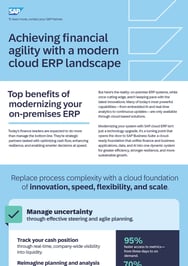
Download SAP’s infographic, Achieving Financial Agility with Cloud ERP, for a quick view of how finance teams can improve visibility, simplify close, and support faster decisions.
Finance in SAP Cloud ERP is bigger than a faster ledger. It’s a cleaner data model, a more controlled close, better consolidation, and faster insight when decisions can still make a difference. If finance leads well, the rest of the transformation has a better foundation to build on.
If you’re evaluating SAP Cloud ERP and want a clearer path for finance, closing, and reporting, let’s talk about what that could look like for your business.
Sources referenced in this article: Finance First, a successfull approach to Cloud ERP, Understanding the Universal Journal in SAP S/4HANA, Universal Journal in SAP Cloud ERP: Real-time financial insights, SAP Advanced Financial Closing, Advanced Financial Closing topic page, and SAP S/4HANA Cloud for group reporting – Release 2508 is generally available.



.png?width=68&height=78&name=medal%20(1).png "medal (1)")
