



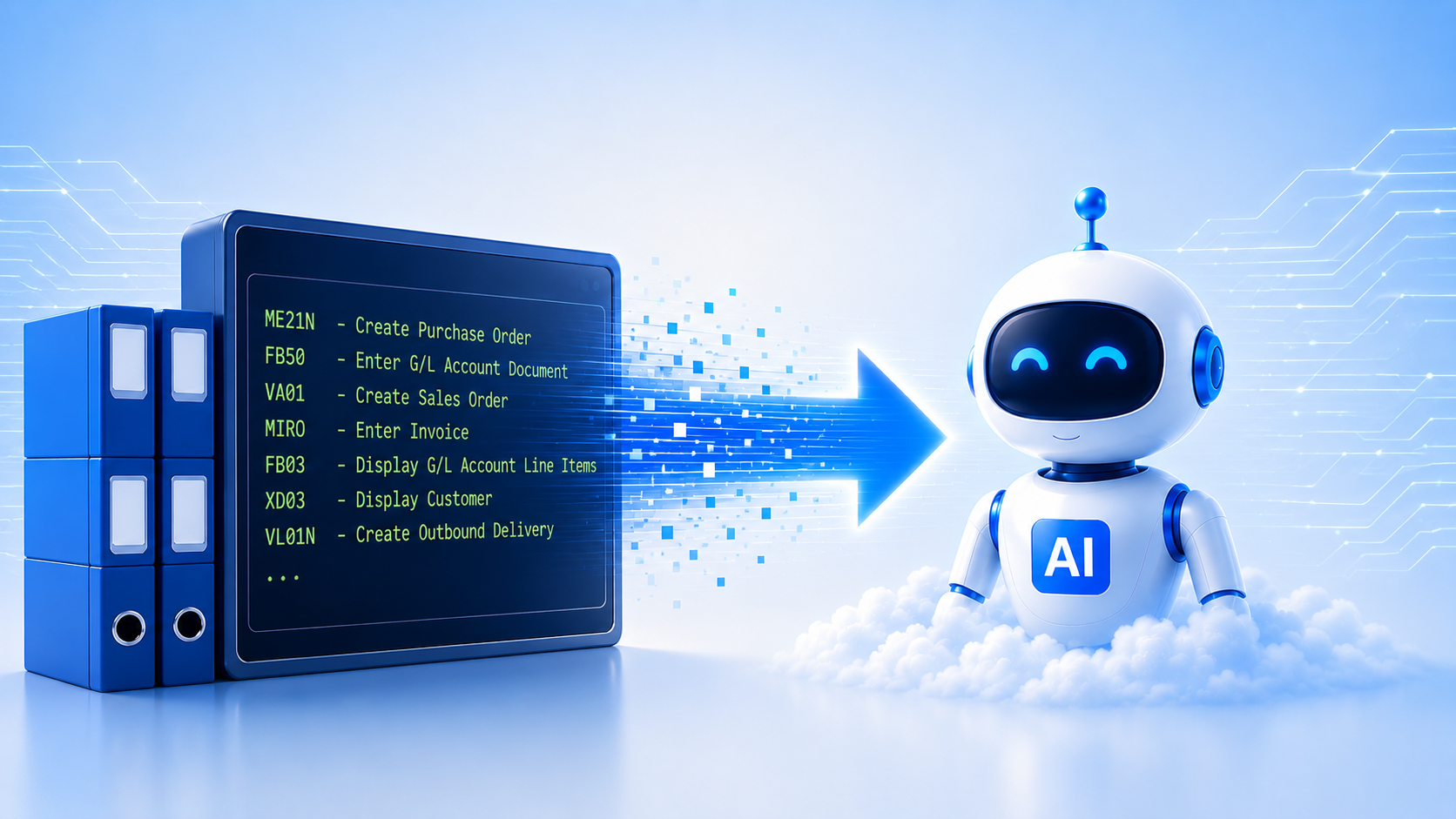
AI is changing ERP, but not in the way many people think. A bot is only useful if the ERP system underneath can give it clean, trusted information. If the process is messy, the data is unreliable, or people still depend on tribal knowledge, a better interface alone will not fix much.
That is the bigger story behind the shift from T-codes to bots. The real question is not whether AI shows up in ERP. It is whether the applications, data, and processes behind that AI are ready to support better work.
Bots only become useful when the ERP foundation is strong enough to support them.
What is changing in practical terms:
For a long time, ERP work rewarded people who knew the shortcuts. If you knew the right transaction code, field, and sequence, you could move quickly. But that also created dependency. New users had to learn where everything lived. Experienced users carried process knowledge in their heads. When people say “from T-codes to bots,” they are not saying transaction codes disappear overnight. They are saying the entry point is changing.
The real shift: the entry point is changing from technical memory to guided action.
Many organizations are still carrying habits formed in ECC. ECC ran core business processes for years and, in many businesses, became deeply tailored to the way work got done. But the path is moving forward. SAP says mainstream maintenance for SAP Business Suite 7 core applications runs until the end of 2027, followed by optional extended maintenance until the end of 2030.
SAP Cloud ERP Private gives companies a bridge to modern cloud ERP while keeping more control than a fully standardized model. SAP says it helps protect existing ERP investments, supports a move to the cloud at the customer’s pace, and provides flexibility in how the environment is run.
Most SAP conversations eventually run into the same three concerns: it is expensive, it is complex, and it takes a long time to implement. Those concerns do not come from nowhere. Many companies have lived through highly customized ERP environments, long project timelines, and systems that became harder to change over time.
It is expensive
Cost usually rises when complexity stays unchecked.
It is complex
Old customization habits often make modernization harder than it needs to be.
It takes too long
Time usually grows when teams try to recreate every old process instead of modernizing with more discipline.
That is why SAP Cloud ERP Private matters here. The goal is not to recreate every old process in a newer system. It is to use standard functionality where it makes sense, follow proven best practices, and keep the core as clean as possible. Complexity usually drives time, and time usually drives cost. A cleaner ERP foundation also makes AI-assisted workflows easier to trust.
Useful AI outcomes usually begin lower down than the bot. If a business wants AI to help with collections, purchasing, production, or service, the system needs reliable process data. Customer balances need to be current. Inventory data needs to reflect reality. Approvals need clear rules. That is why the story is not only AI, then data, then applications. For business outcomes, it often works the other way.
Applications → Data → AI outcomes is often the more honest story.
That matters because ERP is where many of those records already live. Better applications and cleaner process execution create better data. Better data makes AI more useful.
SAP’s Joule architecture guidance describes this shift in three practical ways.
Navigational help
Users can ask where to go and be guided to the right SAP Fiori app or screen.
Transactional help
Users can complete supported tasks more directly through natural language.
Analytical help
Users can ask better questions of business data and get faster insight.
SAP’s Accounts Receivable Agent example shows what that can look like in practice. SAP says it analyzes receivables data such as customer balances, dunning history, and disputed items to provide data-backed insights and recommendations.
SAP describes Joule as an enterprise AI solution embedded across SAP and non-SAP systems, grounded in SAP’s process expertise, harmonized data, and trusted architecture. That grounding matters. A generic bot can sound helpful and still miss the business context. ERP work needs permissions, auditability, process rules, and trusted data.
A generic bot can produce a nice answer and still miss the business context. ERP AI has to work inside real permissions, process rules, and role-based access.
SAP’s architecture guidance also notes that Joule uses existing role and permission context.
That is the more useful leadership question. Not “How fast can we add AI?” but “Are our applications and processes ready for AI to be useful?”
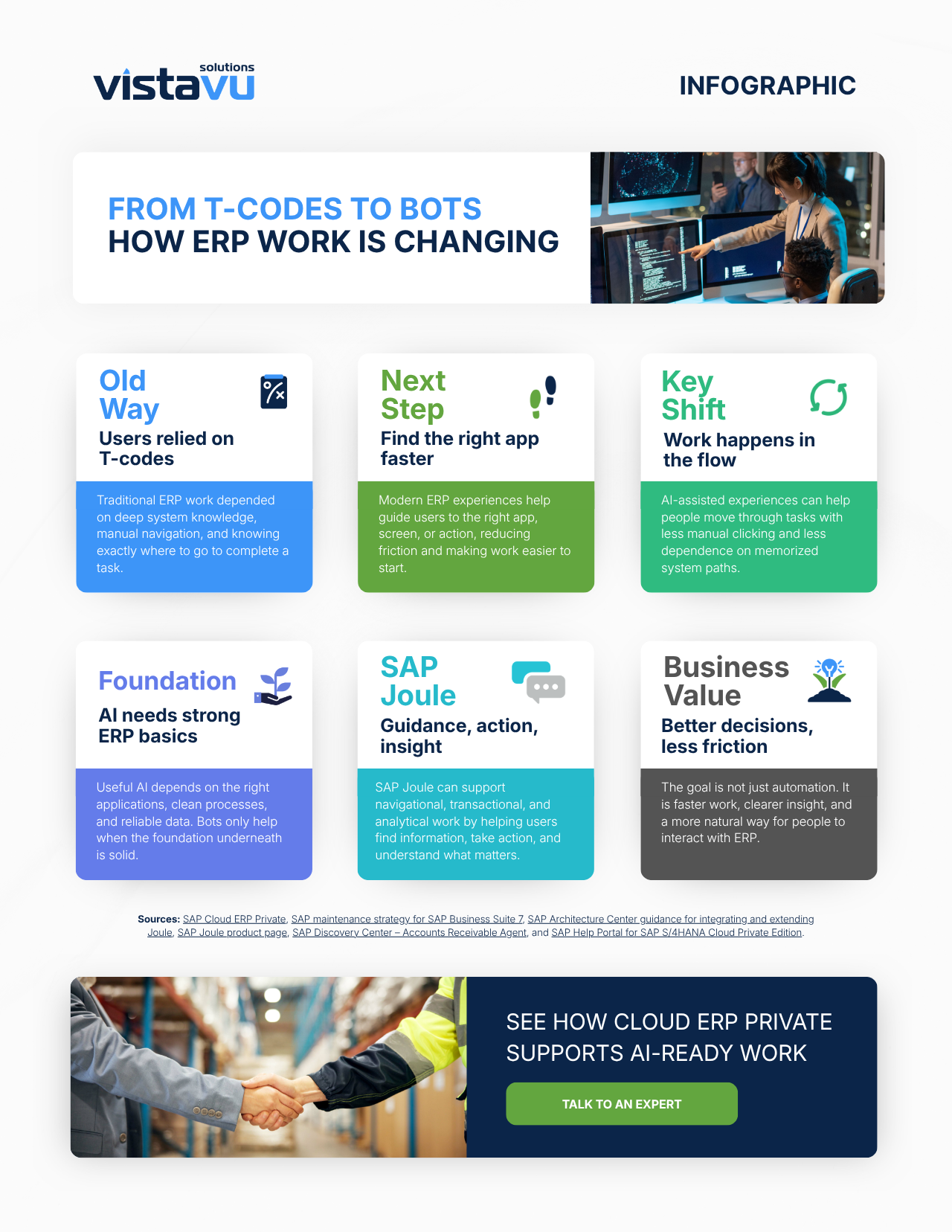
Download SAP’s infographic, From T-codes to Bots: How ERP work is changing, for a quick look at how cloud ERP, guided workflows, and AI are reshaping the way users work in SAP.
SAP Cloud ERP Private supports the move from older ERP habits toward a more guided, AI-assisted way of working. But the value still depends on the foundation underneath. Bots can help, but none of it works well if the applications, data, and processes behind the scenes are not ready.
If you think SAP Cloud ERP Private could help your business and want guidance on connecting AI, process design, and ERP modernization to real business outcomes, let’s talk about what that could look like for your team.
Sources referenced in this article: SAP Cloud ERP Private, SAP maintenance strategy for SAP Business Suite 7, SAP Architecture Center guidance for integrating and extending Joule, SAP Joule product page, SAP Discovery Center – Accounts Receivable Agent, and SAP Help Portal for SAP S/4HANA Cloud Private Edition.



.png?width=68&height=78&name=medal%20(1).png "medal (1)")
