


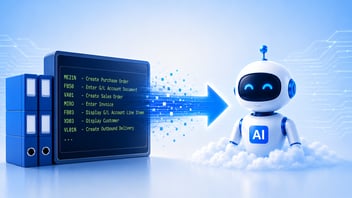

If your supply chain team is still chasing updates across spreadsheets, emails, and disconnected systems, the problem usually isn’t effort.
Most supply chain problems aren’t caused by lack of effort. They’re caused by lack of visibility.
IDC’s February 2026 white paper on SAP Cloud ERP for SCM found that companies improved fulfillment, productivity, and cost control when planning, inventory, fulfillment, and related data were brought into one connected ERP environment.
That matters because supply chain performance rarely breaks at one point. It usually breaks at the handoffs between planning, purchasing, warehousing, logistics, finance, and customer service.
Quick context: SAP’s article on ERP in supply chain management makes the same point from another angle: ERP helps connect planning, procurement, manufacturing, logistics, maintenance, sustainability, finance, and customer service so teams can work from the same picture.
The biggest shift is not just that everything is in one system. It’s that cloud ERP changes the pace of decision-making.
That’s the part SAP calls out clearly: cloud ERP helps teams move faster without being held back by hardware limits, slow updates, or rigid systems.
IDC’s research adds the operational proof. It found that SAP Cloud ERP for supply chain management, built on SAP S/4HANA Cloud, helped organizations improve automation, inventory turns, order fulfillment, and team productivity. The business value snapshot makes that case in one page.
79%
more inventory automation
25%
fewer unfulfilled orders
34%
higher supply chain team productivity
406%
three-year ROI
IDC also reported 21% faster inventory turns, 12% higher on-time delivery, 22% fewer warehouse errors, 22% higher productivity for transportation teams, and 21% more efficient supply chain platform management. In plain terms, teams spend less time correcting, chasing, and reconciling—and more time planning ahead.
The financial case is strong too: $367,900 in average annual benefits per 100 employees, $539,900 in higher annual revenue per 100 employees, and a nine-month payback period. The full IDC paper goes deeper into the math behind those numbers.
IDC’s Unlock Supply Chain Success infographic adds an important layer here. It shows 67% of organizations see ERP deployment in the cloud as important to very important because it gives them access to new innovations, including AI. It also says 55% already deploy ERP in the cloud to get the full benefit of AI, and 46% plan to do so in the next 12–24 months.
That lines up with what SAP describes in its cloud ERP article: AI, real-time collaboration, IoT, mobile access, and blockchain all become easier to use when the foundation is cloud-based and connected.
Cloud ERP won’t fix broken processes by itself. IDC warns that companies still stuck in siloed, legacy ways of working may not get the full benefit of the move.
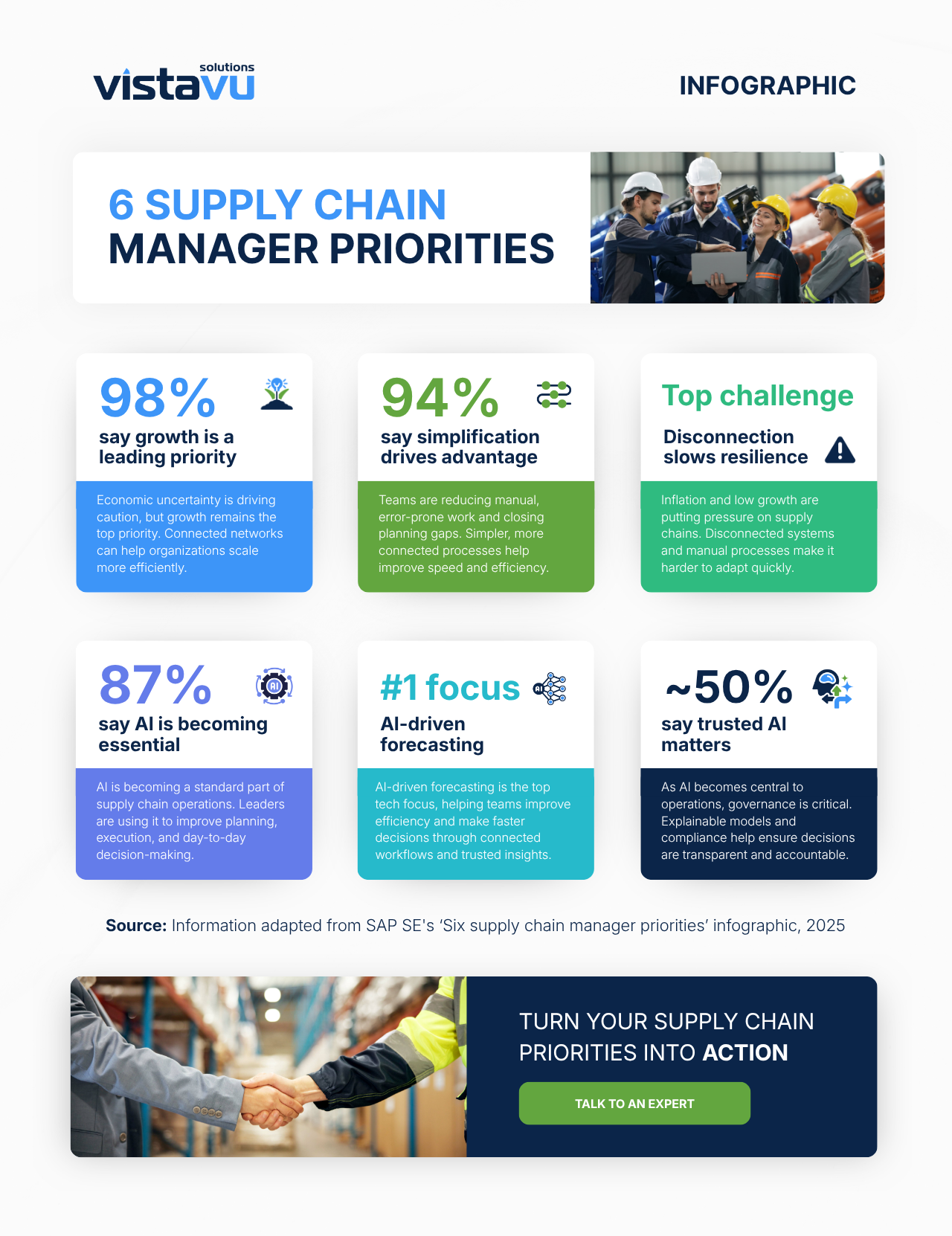
Download our infographic, 6 Supply Chain Manager Priorities, for a quick snapshot of the trends and priorities shaping supply chain decisions today.
For supply chain leaders looking at SAP Cloud ERP Public, the case is straightforward: a connected cloud ERP approach can give teams better visibility, better timing, and fewer manual slowdowns. And when the system is cloud-based, it becomes easier to scale, adapt, and keep improving.
If supply chain visibility gaps, planning issues, or too much manual work are slowing your team down, let’s talk about what a better-connected ERP approach could look like for your business.
Sources referenced in this article: IDC The Business Value of SAP Cloud ERP for SCM, IDC Infographic - The Business Value of SAP Cloud ERP SCM, IDC - Unlock Supply Chain Success, and The value of ERP in supply chain management.



.png?width=68&height=78&name=medal%20(1).png "medal (1)")
